Friday, April 29, 2016
On the Allotment - Mile End Arts Pavilion

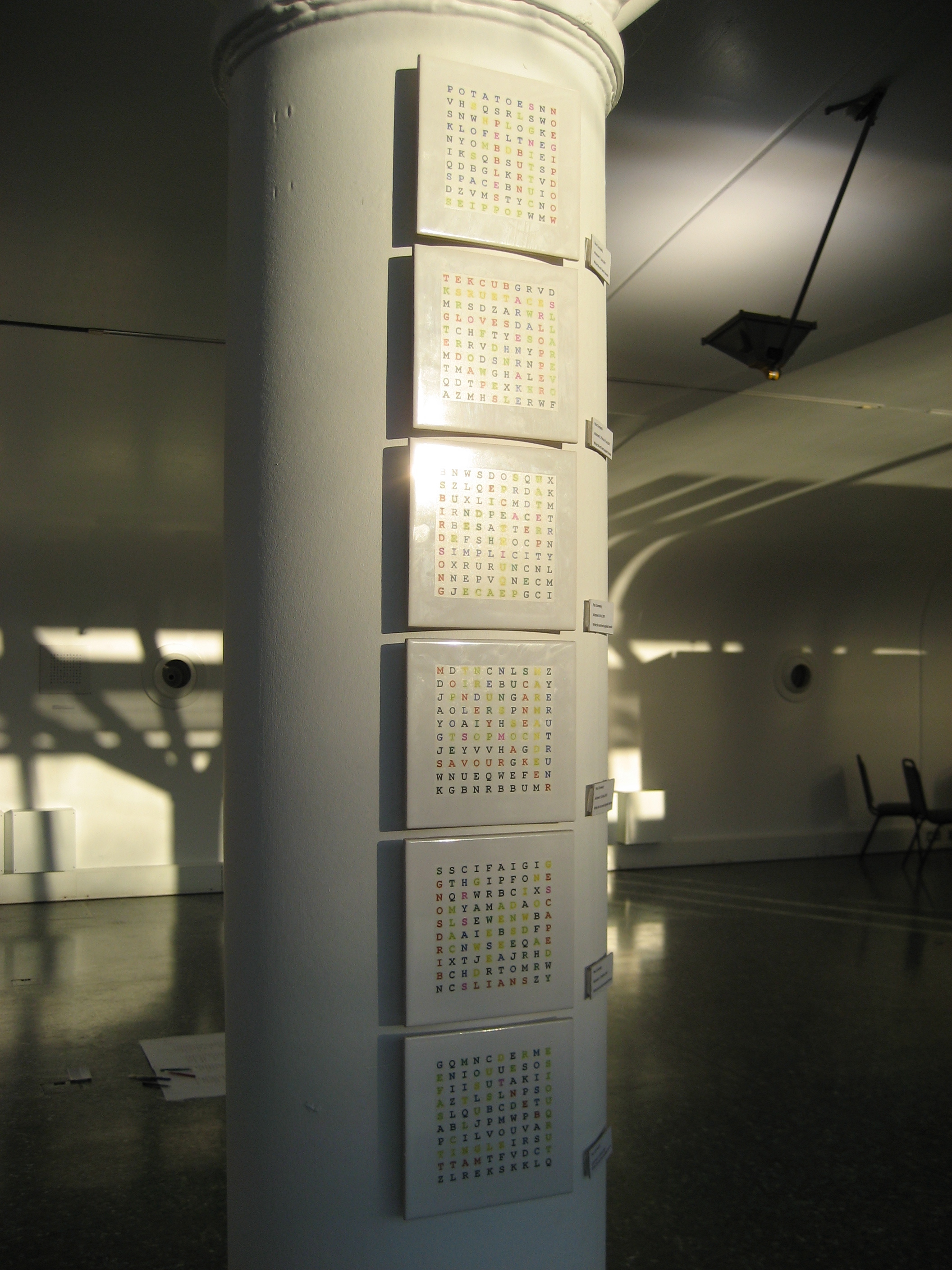
'On the Allotment'
One Off Ceramic Tile Series
Paul Conneally
Mile End Arts Pavilion, London, 2006
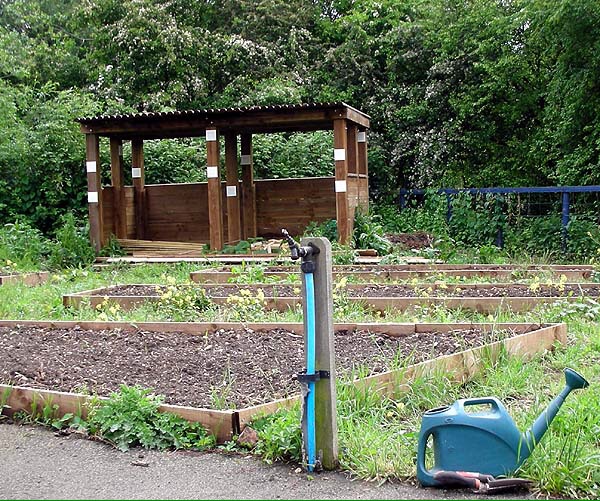
"Allotment holders on the Windmill Allotments in Nottingham talked with me about their time 'on the allotment' and shared with me ten words or short phrases that came to mind on that day, at that time, on the allotment. I then used these to create 'wordsearch portraits' of them. Their words were coloured using a strict system approach with each wordsearch being both a portrait and a poem of that person on their allotment at that time. The portraits were initially laid down on concrete paving stones within Windmill Community Gardens and then made into one off ceramic tiles which formed part of The Renewability exhibition at Mile End Arts Pavilion in London. After the show the tiles were returned to Windmill Community Gardens and installed on an open shed structure to become 'The Portrait Shed' where they slowly changed with the weather and the seasons eventually cracking, breaking, becoming crocks for plant pots."
Paul Conneally

The Portrait Shed - Paul Conneally 2007
Labels:
Allotments,
art,
environmental art,
Little Onion,
London,
Mile End Arts Pavilion,
Nottingham,
paul conneally,
portrait,
shed,
sheds,
text art
Wednesday, April 27, 2016
Nice To See You To See You Nice

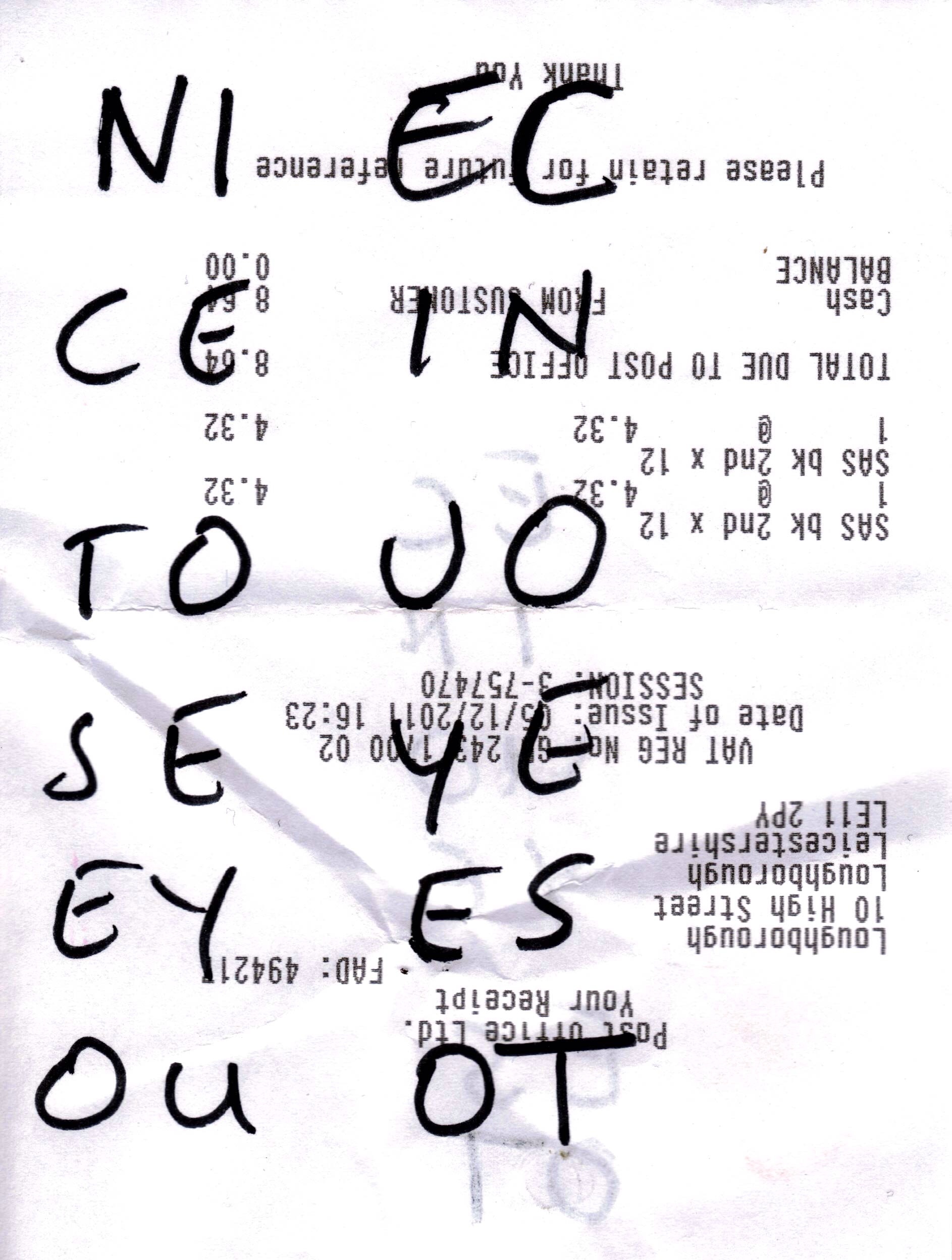
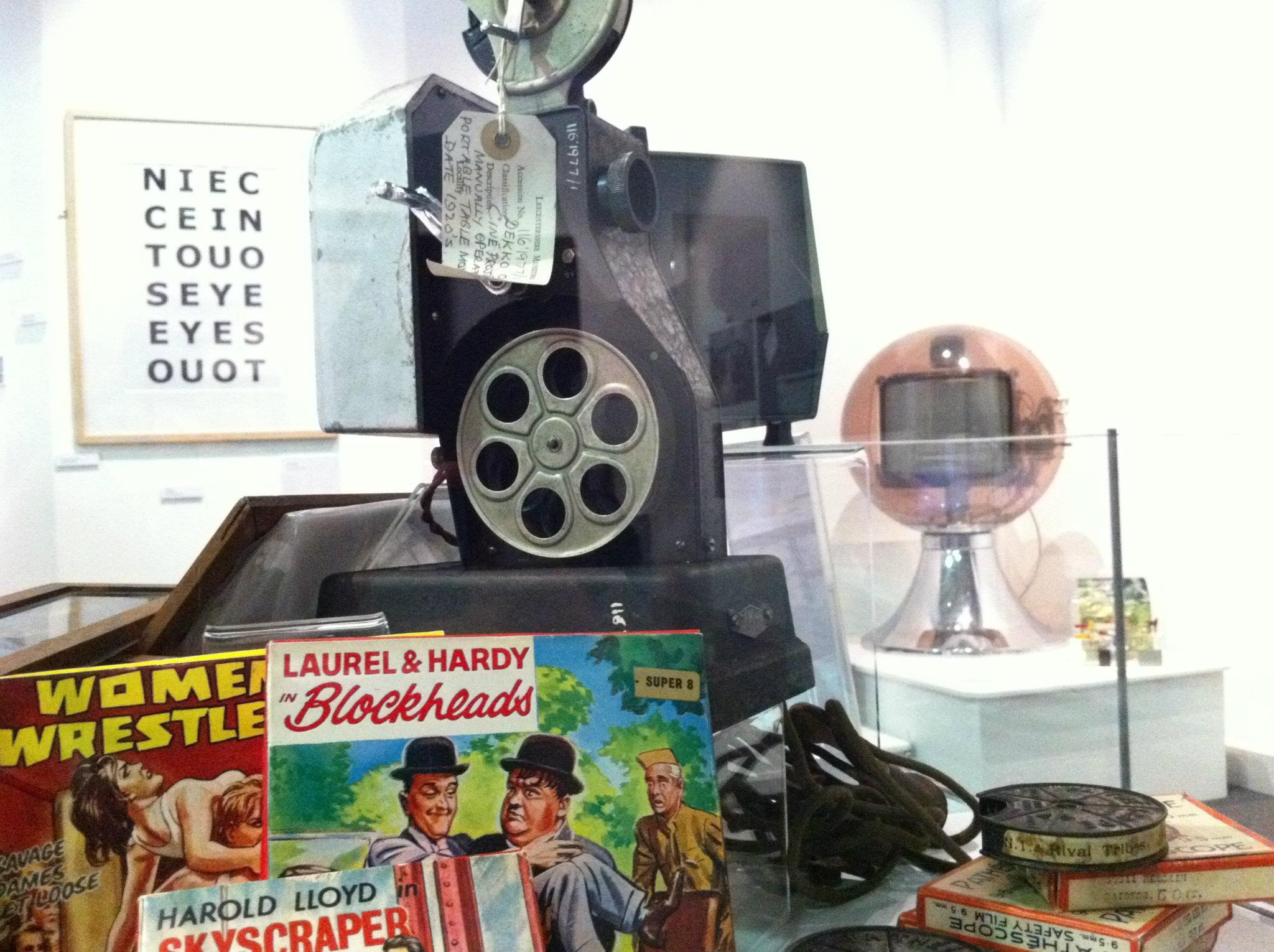
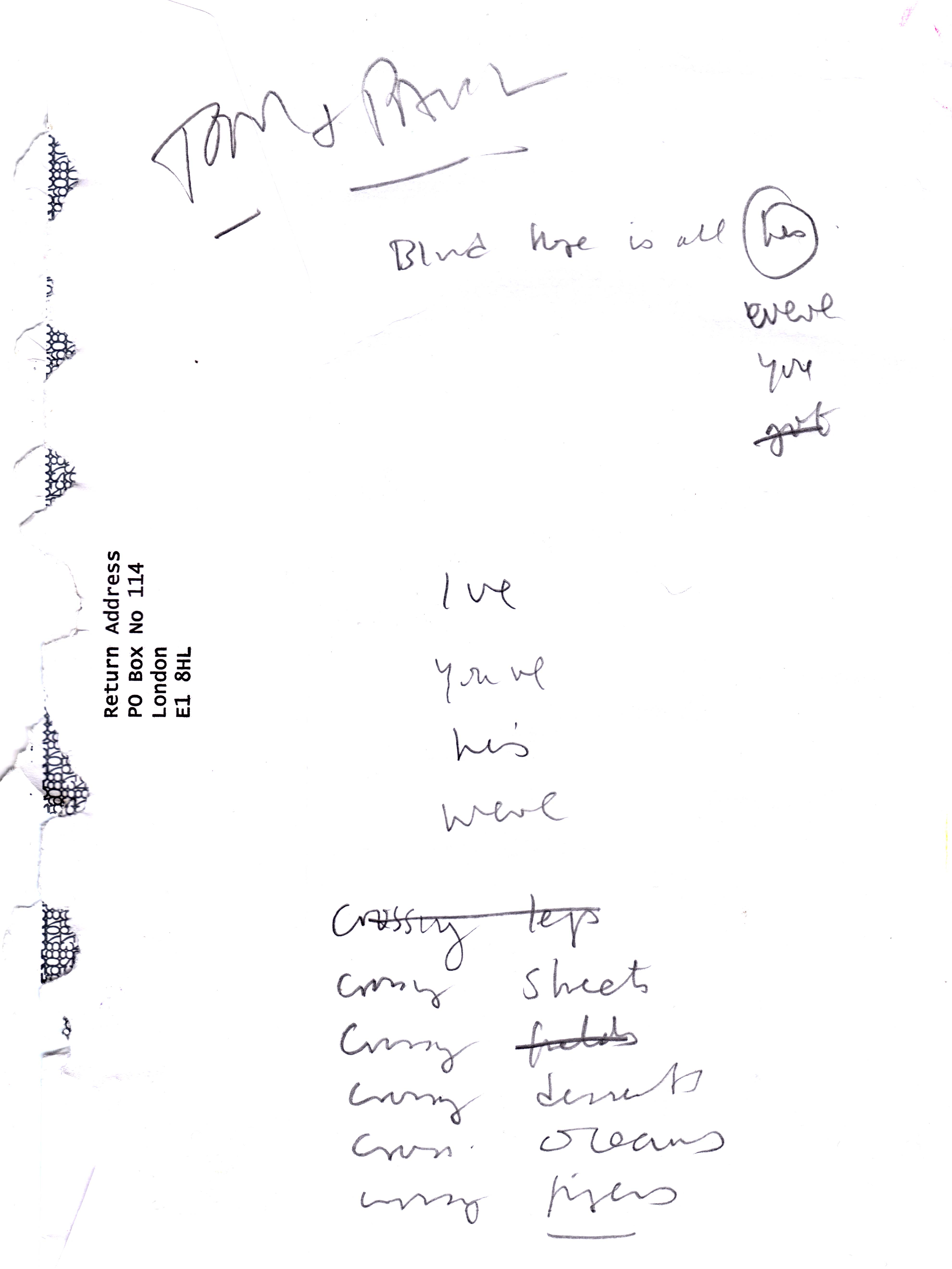
Above is the working document, a receipt from the local post office, for the text based piece 'NICE TO SEE YOU' that was exhibited as part of my show 'The Blind Fiddler Home Entertainment 1806 - 2012' show at Snibston Discovery Museum. Below is how it appeared in the exhibition. The show could not have been realised without the help of the wonderful curator Alison Clague - Paul Conneally April 2016

Tuesday, April 26, 2016
Friday, April 22, 2016
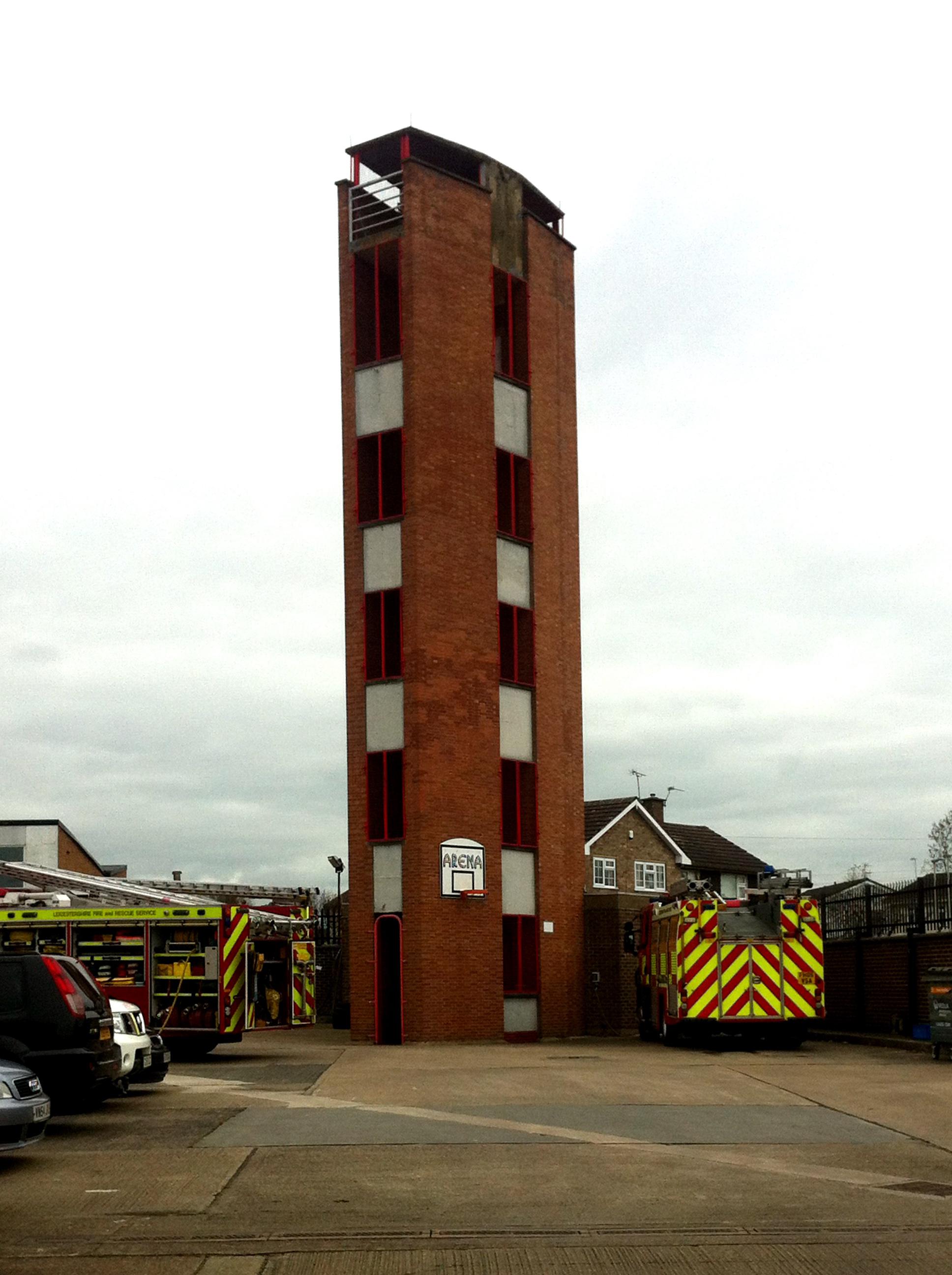
Blossom Breeze
Labels:
architecture,
building,
Fire Station,
firefighter,
fireman,
haiku,
Leicester,
Little Onion,
poetry
Wednesday, April 20, 2016
Sunday, April 17, 2016
Second Half Rush

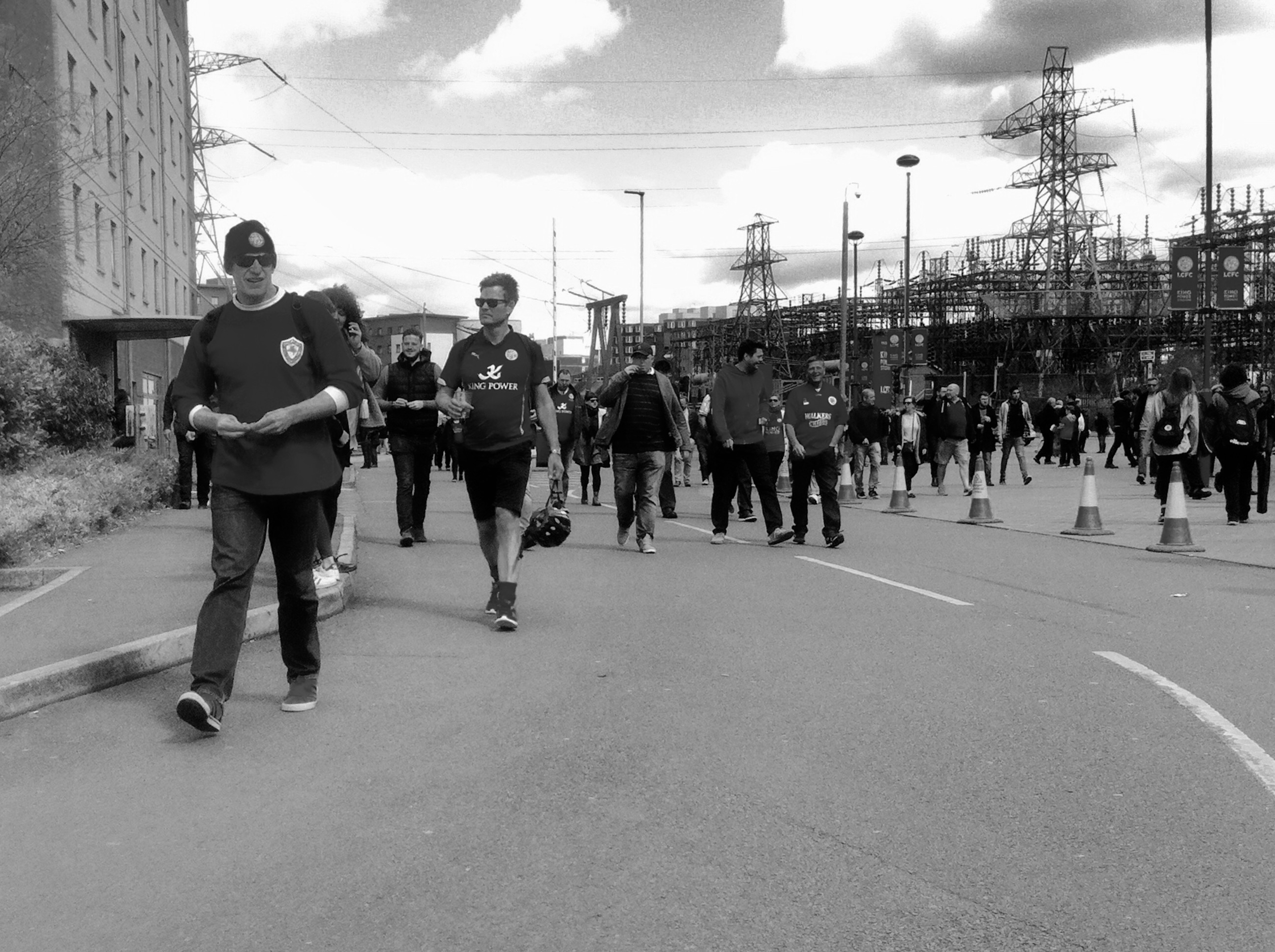
Walking down Filbert Way these fans have a swagger about them not seen in Leicester before. Against all the odds their team, Leicester City, sit at the top of the English Premier League, the EPL, with only five matches to play. Wether they eventually win the Premiership or not they are already secured a place in the Champions League in the 2016/15 season something that seemed inconceivable at the start of this season.
second half rush
too excited to eat
my half-time pie
Little Onion
April 2016
Photo:Leicester City Football Fans, Paul Conneally, King Power Stadium, April 17 2016
Sunday, April 10, 2016
Friday, April 08, 2016
The Floodgates Open

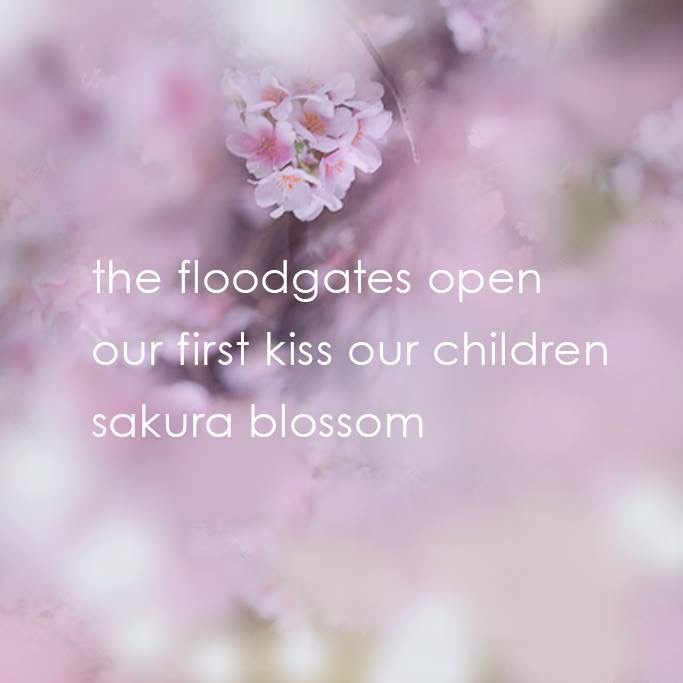
the floodgates open
our first kiss our children
sakura blossom
Little Onion
For and with the modern authentic Japanese restaurant Sake no Hana
.
.
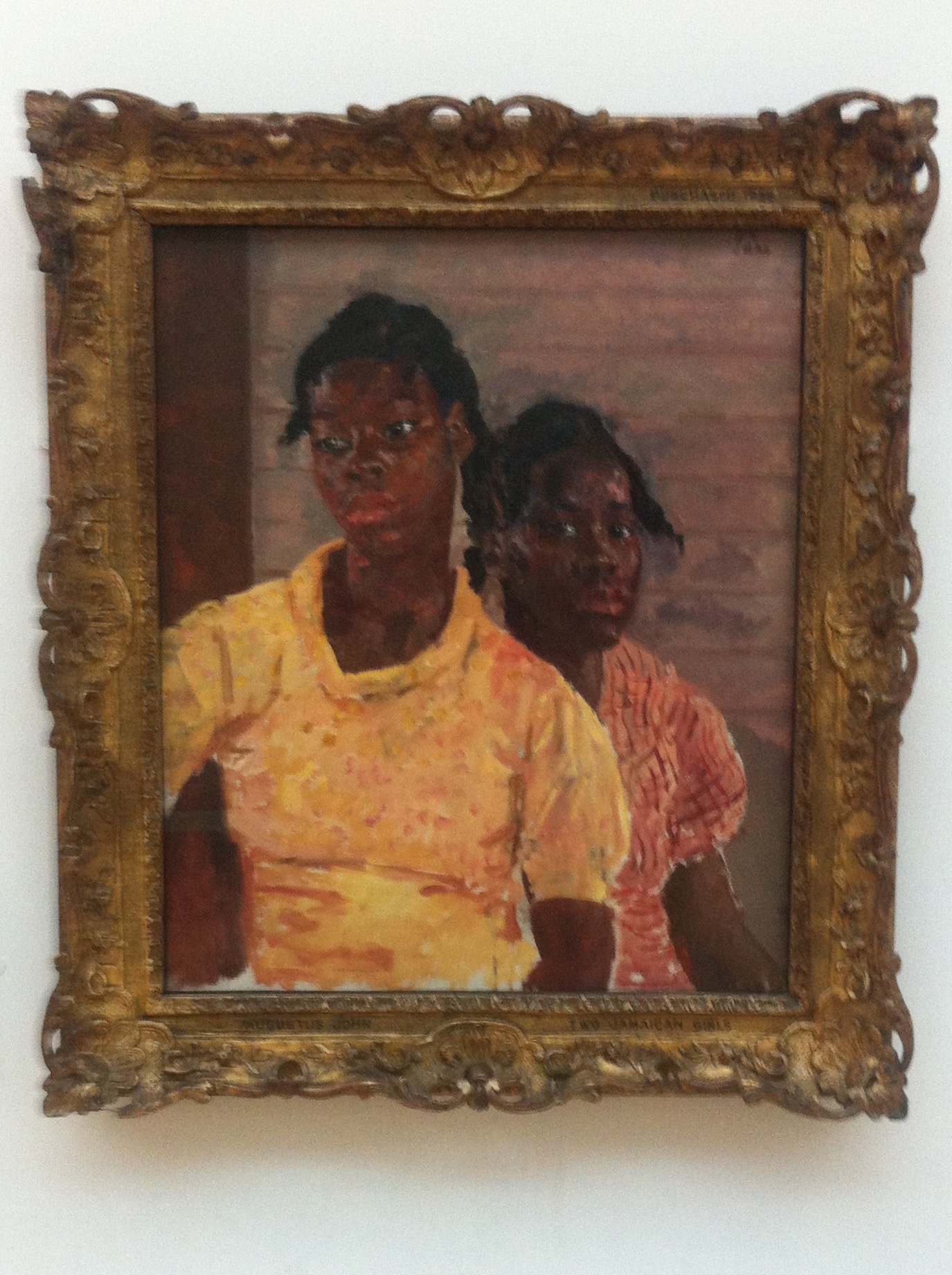
Two Jamaican Girls

Two Jamaican Girls - Augustus John 1937
This painting is in The Walker Gallery, Liverpool, UK.
It seems to shout across the room "Come look at me!"
Wyndham Lewis describes the artist, Augustus John, as:
‘a great man of action into whose hands the fairies had placed a paintbrush instead of a sword’.
If you are in Liverpool a visit to The Walker Gallery is a 'must do' - do it!
Paul Conneally
April 2016
.
.
Labels:
1937,
art,
Augustus John,
girls,
Jamaica,
Jamaican Girls,
Liverpool,
painting,
portrait,
portraiture,
The Walker Gallery
Thursday, April 07, 2016
One Hundred Men

We take my mum and dad, both in their eighties, to Liverpool for a couple of days. My mum has wanted to see Anthony Gormley's 'Another Place' for a long time. A cold, windy and wild day at Crosby beach. Together we watch the tide go out, slowly revealing one hundred metal statues, casts of Gormley himself, naked, looking out to sea.
blowing its horn
the ferry heads west
mating gulls
Little Onion
Photograph: Paul Conneally, Crosby, April 2016
. . . . . .
.
.
.
Labels:
Another Place,
Anthony Gormley,
beach,
coast,
haibun,
haiku,
Little Onion,
Liverpool,
paul conneally,
photography,
poetry,
sculpture
Saturday, April 02, 2016
Cherry Blossom Moon
stuck to the bottom
of his patent leather shoe
cherry blossom moon
Little Onion
for Sake no Hana the modern authentic Japanese restaurant in London
Labels:
cherry blossom,
haiku,
Japanese food,
Little Onion,
London,
paul conneally,
poetry,
sake no Hana
Friday, April 01, 2016
Thursday, March 31, 2016
'The Don Juan Deli' Moving On - Involuntary Painting 2 New Parks : New York

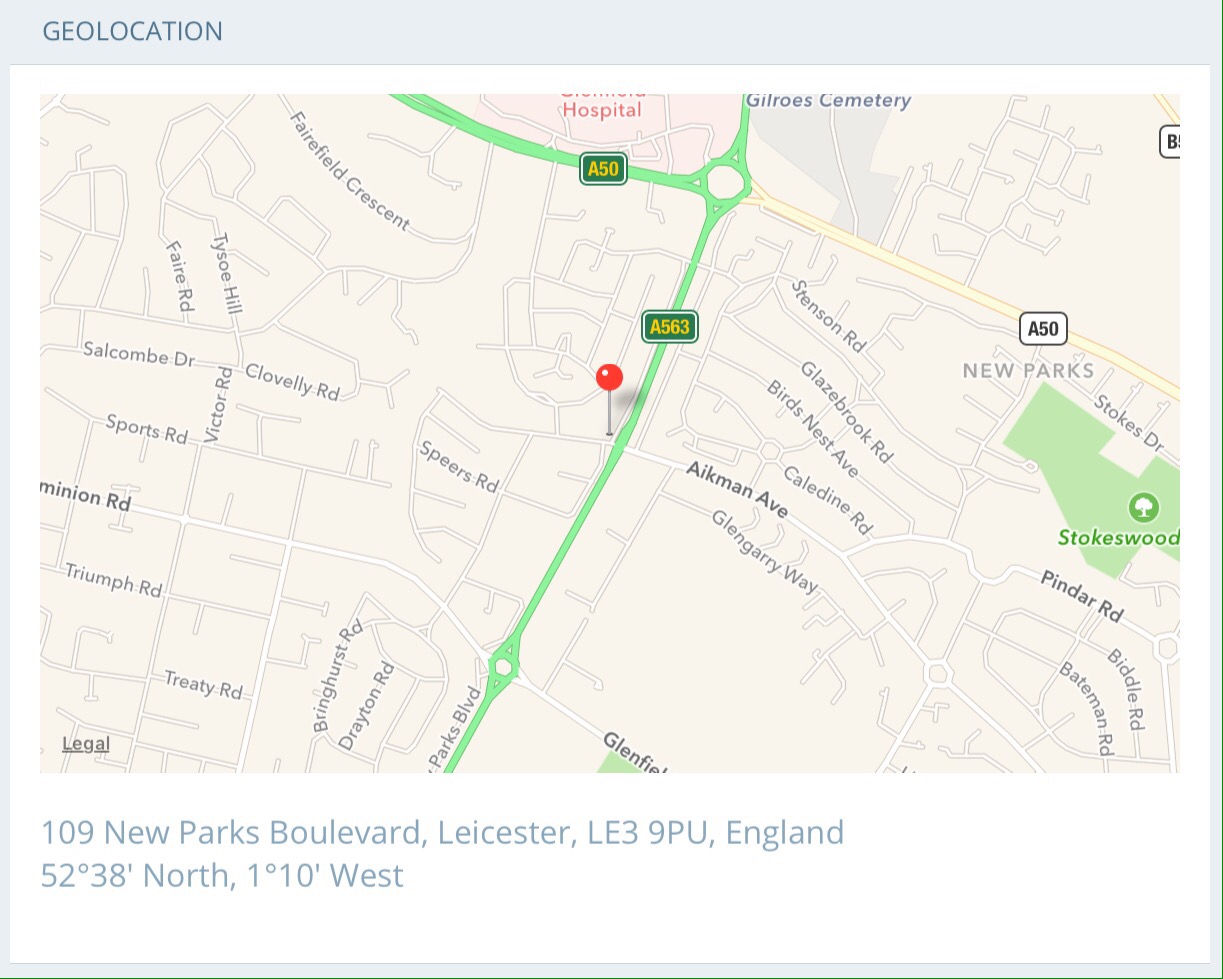
This map shows the transposed location of New York's 'Don Juan Deli' from Forsyth Street in New York to New Parks in Leicester.

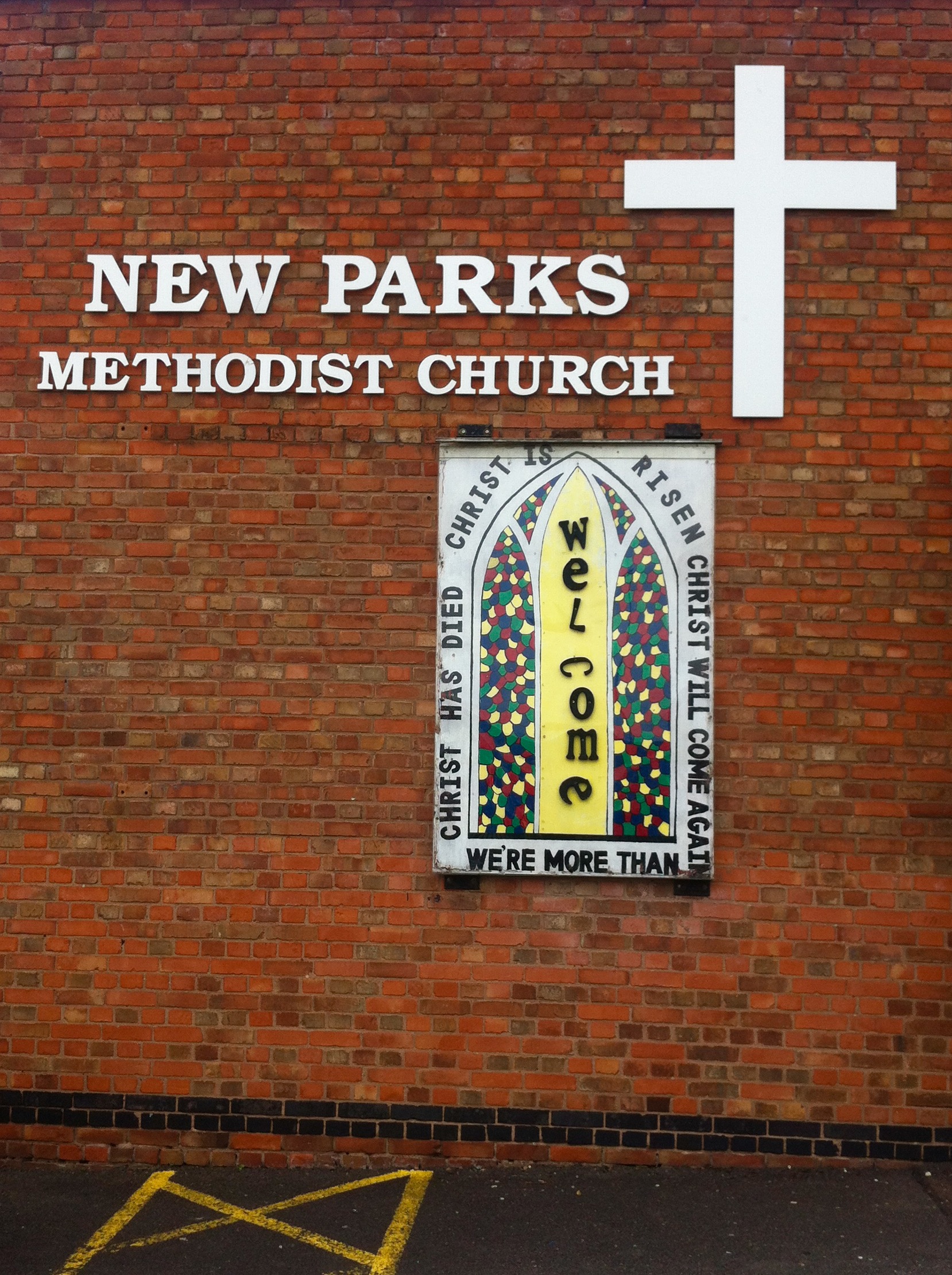
It's location in New Parks was discovered by the Creative New Parks Group walking out with artist Paul Conneally from New Parks Centre Library following the directions given to them by New York artist, Brad Melamed, from his home in New York to the Don Juan Deli.
The Don Juan Deli is at the site of a ventilation tower for the now disused Glenfield Tunnel which was only the second such railway tunnel ever built on a passenger line. It was designed by the famous railway engineer George Stephenson and built between 1829–32 under the supervision of his son Robert.

This ventilation tower is now named 'The Don Juan Deli' and will feature on the new map of New Parks coming out of 'Moving On - Involuntary Painting 2 New Parks : New York' by artists Millree Hughes (New York) and Paul Conneally (Loughborough).

Here's Christine Blackmore working on the map in New Parks Centre Library:

'Moving On - Involuntary Painting 2 New Parks : New York' is a work by artists Millree Hughes (New York) and Paul Conneally (Loughborough) with and for Soft Touch Arts, Leicester City Council and Arts Council England.
Wednesday, March 30, 2016
Robert Rauschenberg's Studio - New Parks, Leicester

'Robert Rauschenberg's Studio - Charnor Road, New Parks, Leicester'
As part of artists Millree Hughes (New York) and Paul Conneally's (Loughborough) work 'Moving On - Involuntary Painting 2 New Parks : New York' a group of New Park's residents set off with Conneally from New Parks Centre Library to find Robert Rauschenberg's New York Studio in New Parks.
They follow the directions, lefts, rights and straight overs, sent to them by New York artist Brad Melamed of the walk from his apartment building in New York to Rauschenberg's building in New York.
After a brief altercation with road workers on New Parks Way the group finally locate Rauschenberg's studio, a bus shelter on Charnor Road, almost opposite Forest Lodge Education Centre. They have their photograph taken standing in the studio.

Robert Rauschenberg's Studio (rear view) New Parks, Leicester
The bus shelter is now a work of public art and will be labelled as such:
'Robert Rauschenberg's Studio'
Millree Hughes - Paul Conneally - Brad Melamed
The Creative New Parks Group
March 2016
The artists encourage you to visit the work, have your photograph taken in it, catch a bus.
'Moving On - Involuntary Painting 2 New Parks : New York' is a project led by artists Millree Hughes and Paul Conneally with and for Soft Touch Arts, Leicester City Council and Arts Council England
The Rushes Rotunda - Leicester

The Rushes Rotunda - Loughborough
I've never really noticed Rushes Rotunda before, we'll never in a positive way, until today.
As I make my way from the outside upper tier of the The Rushes car park towards Marks & Spencer suddenly the Rotunda speaks to me. It's not tall like Birmingham's Rotunda and is devoid of ornamentation save for a a security alarm labelled 'SMS', a couple of CCTV cameras and a text message on the glass above the door:
passenger lifts to
lower ground floor
car park
which might just pass as a text based poetic ' involuntary painting' at a push.
I don't feel tempted to enter although I might next time I'm here, specifically to try and access the upper floor which I presume is at the moment just for service access, the elevator mechanism, but must give a view of Loughborough not often seen, across the roofs of this small shopping mall and across the town itself.
Generally disappointed with my excursions through and into The Rushes, the Pound Shop reading glasses display a welcome diversion, today somehow, someway it feels different.
Maybe it's the spring breeze working its magic.
shopping for nothing
a hanging basket
of purple faced pansies
Little Onion
March 2016
Paul Conneally
Sunday, March 27, 2016
Leicester Suffragettes

Leicester Suffragettes: "Always and always facing toward the light"
Read about Leicester's Alice Hawkins - A Sister of Suffrage
Friday, March 25, 2016
Good Friday - Paul Conneally and Debra Woolard Bender 5-8-00
haikumania
linked poems created via electronic mail
Good Friday
a *loaforenga
Paul Conneally & Debra Woolard Bender
Good Fridaybreakfast of hot cross bunson a cracked platepretty waitress - - the young vicar spills teawet warmth spreads through a brown tweed suitsoiled pyjamas thrown under the bedpotty full of flowers by the front doorseed packets on tongue depressorsice lolly stick stuck in the drainslow van trailing music and childrenthe neighbour's boy plays tin-can soccerjersey and cleats in moth ballssix butterflies on the Lilac treegarden wedding - - bride's mother wipes away tearsthe taste of saltbetween two loversfine times and fouleven the sea brings giftsto storm ravaged shoresa turtle buries her eggs in the duneplastron - - future past written on shellsthe milkman consults his book of changeshanging on the wall - - no green bottlesbaskets of pansies sway in the windthis way and that - - a weathercock spinscop on point duty waves to his dadrail commuters race the whistlemarathon runners going through painquick ladders up her nylon hosefinding this time easier than the lastprimary examdivision problems solvedon five fingers
------------------------------------------------------------------------------------------------------------------------------------------------
Loaforenga Instructions & History
The Loaforenga is a new-form renga. Hybrenga (hybrid renga)is the concept of combining several Asian verse forms into one renga-style poem. The Loaforenga hybrenga combines 4 verse forms, in one 5-sectioned poem:
(1)Lorenga, (1)Forenga (2)haiku, (1)tanka
The hybrenga concept and Loaforenga form were created by Debra Woolard Bender and Paul Terence Conneally in April 2000.
The Lorenga is a new-form renga created by ai li as shown on her website, "still." We have used the Lorenga to form part of the structure of our "Lost and Found" (Lo-a-fo-renga hybrenga. Paul created the Forenga as our counterpoint to the Lorenga form.
The Loaforenga is most suitable for 2 or 3 players although bigger groups could play. The theme of the Lorenga's last line must be loss. The theme of the Forenga's last line must be something found. The Loaforenga follows the traditional renga linking rules throughout the entire poem.
The form for two players is as follows:
Haiku/ A
Lorenga/ BABABABABAB (11 one liners/ last line refers to "loss")
Tanka/ AAA BB
Forenga/ ABABABABABA (11 one liners/ last line refers to "finding")
Haiku/ B
____________________________________
The form for three players is:
Haiku/ A
Lorenga/ BCABCABCABC (11 one liners/ last line refers to "loss")
Tanka/ BBBAA
Forenga/ CABCABCABCA (11 one liners/ last line refers to "finding")
Haiku/ C
Poetry � Paul Terence Conneally (UK ) and Debra Woolard Bender (USA )
ai li's 'New Linked Forms' has explanations and examples of a large number of new linked forms with guidelines - all of them are suitable for connecting and creating with others around the world via electronic mail or by connecting in the chemically coded world perhaps around the kitchen table or in the park...
back to haikumania main index
Labels:
art,
collaborative poetry,
culture,
haiku,
linked poetry,
paul conneally,
renga,
renku
Wednesday, March 23, 2016
New Portraits from the 'New Parks Involuntary Painting Bus ShelterPhoto Booth'
'Dazzo, Sally and Sienna'
'Colin'
'Christine'All the photographs were taken on Monday March 21st 2016 by Paul Conneally as the Moving On Involuntary Painting 2 New Parks : New York group made its way back from finding Robert Rauschenberg's New York studio in New Parks, Leicester following in the transposed footsteps of New York artist Brad Melamed. The work is part of Conneally's ongoing collaboration with New York artist Millree Hughes with and for Arts Council England, Soft Touch Arts and Leicester City Council.
Sunday, March 13, 2016
Fast Messengers 飛脚 (hikyaku)
Hikyaku were couriers or messengers active in the medieval and early modern periods, who transported currency, letters, packages, and the like. In the Edo period, the network of hikyaku messengers expanded dramatically, and also became more organized and systematized.
Sando hikyaku (三度飛脚) traveled the Tôkaidô three times a month, and were generally employed by shogunate officials in Osaka and Kyoto to communicate with the shogunatein Edo. The messengers made use of horses made ready at post towns along the way - in theory, three horses ready and available at any given time - to ensure they would always have a fresh horse and thus the ability to travel more quickly.
The same term, sando hikyaku, was also used to refer to an independent network of messengers (i.e. not working directly for the shogunate) who operated commercially in transporting messages and goods along the Tôkaidô, beginning around 1664. These commercial messengers were also known as jô bikyaku in Edo, and junban hikyaku in Kyoto, and operated out of roughly 86 establishments in Kyoto and at least nine in Osaka, with branch operations in Edo, and roughly twenty post-stations along the route. A much smaller group of messenger operators, known as jôge hikyaku (上下飛脚) or rokkumi hikyaku (六組飛脚) were based in Edo, and specialized in transporting materials for provincial daimyô. The Kyoto/Osaka-based messengers soon expanded their business, establishing routes connecting those cities with Tanba and Harima provinces, and with major provincial cities such as Sendai, Nagasaki, Kanazawa, and Fukui. Each company ran on a different schedule, generally sending and receiving messengers three times every ten days; a manager called a sairyo oversaw operations and took responsibility for the safety of packages.
The shogunate also operated a network of messengers along all five major highways (the Gokaidô) called tsugi hikyaku (継飛脚), to convey official messages to shogunate and daimyô domains. Horses were kept ready at stations called tsugitate, spaced roughly eight kilometers apart, for use by the messengers.
Some of the most powerful daimyô maintained their own messenger networks, called daimyô hikyaku or shichi-ri-hikyaku, as these networks generally had horses ready every seven ri (shichi-ri). The two most prominent daimyô who maintained such networks were the Gosanke Tokugawa branch families based in Wakayama and Nagoya. Messengers in the service of Wakayama han left Edo on the 5th, 15th, and 25th of each month, and left Wakayama on the 10th, 20th, and 30th.
All in all, the time it took to convey messages from Osaka to Edo or vice versa, across 500 km, settled into a standard of six days by the end of the 17th century; in the 18th century, as the economy boomed and road and river traffic increased, delays due to congestion and other factors increased as well, and what once took six days now more frequently took ten or twelve. Meanwhile, however, commercial messenger services sought ways to cut down their times, and soon haya hikyaku (quick messengers) were making the journey in five, four, or as little as three and a half days, gaining time by running at night, and by making stops at fewer stations. In the 19th century, messengers somehow managed to cut the time even further, making the journey in as little as two days. However, these super express services were quite expensive, costing as much as four, or even eight or nine ryô for three-and-a-half day delivery of a message.
Text shared by Little Onion from: http://wiki.samurai-archives.com/index.php?title=Hikyaku
Sando hikyaku (三度飛脚) traveled the Tôkaidô three times a month, and were generally employed by shogunate officials in Osaka and Kyoto to communicate with the shogunatein Edo. The messengers made use of horses made ready at post towns along the way - in theory, three horses ready and available at any given time - to ensure they would always have a fresh horse and thus the ability to travel more quickly.
The same term, sando hikyaku, was also used to refer to an independent network of messengers (i.e. not working directly for the shogunate) who operated commercially in transporting messages and goods along the Tôkaidô, beginning around 1664. These commercial messengers were also known as jô bikyaku in Edo, and junban hikyaku in Kyoto, and operated out of roughly 86 establishments in Kyoto and at least nine in Osaka, with branch operations in Edo, and roughly twenty post-stations along the route. A much smaller group of messenger operators, known as jôge hikyaku (上下飛脚) or rokkumi hikyaku (六組飛脚) were based in Edo, and specialized in transporting materials for provincial daimyô. The Kyoto/Osaka-based messengers soon expanded their business, establishing routes connecting those cities with Tanba and Harima provinces, and with major provincial cities such as Sendai, Nagasaki, Kanazawa, and Fukui. Each company ran on a different schedule, generally sending and receiving messengers three times every ten days; a manager called a sairyo oversaw operations and took responsibility for the safety of packages.
The shogunate also operated a network of messengers along all five major highways (the Gokaidô) called tsugi hikyaku (継飛脚), to convey official messages to shogunate and daimyô domains. Horses were kept ready at stations called tsugitate, spaced roughly eight kilometers apart, for use by the messengers.
Some of the most powerful daimyô maintained their own messenger networks, called daimyô hikyaku or shichi-ri-hikyaku, as these networks generally had horses ready every seven ri (shichi-ri). The two most prominent daimyô who maintained such networks were the Gosanke Tokugawa branch families based in Wakayama and Nagoya. Messengers in the service of Wakayama han left Edo on the 5th, 15th, and 25th of each month, and left Wakayama on the 10th, 20th, and 30th.
All in all, the time it took to convey messages from Osaka to Edo or vice versa, across 500 km, settled into a standard of six days by the end of the 17th century; in the 18th century, as the economy boomed and road and river traffic increased, delays due to congestion and other factors increased as well, and what once took six days now more frequently took ten or twelve. Meanwhile, however, commercial messenger services sought ways to cut down their times, and soon haya hikyaku (quick messengers) were making the journey in five, four, or as little as three and a half days, gaining time by running at night, and by making stops at fewer stations. In the 19th century, messengers somehow managed to cut the time even further, making the journey in as little as two days. However, these super express services were quite expensive, costing as much as four, or even eight or nine ryô for three-and-a-half day delivery of a message.
Text shared by Little Onion from: http://wiki.samurai-archives.com/index.php?title=Hikyaku
Labels:
Edo,
heritage,
Hikyaku,
history,
Japan,
Little Onion,
old photographs,
photography,
postal service
Subscribe to:
Posts (Atom)